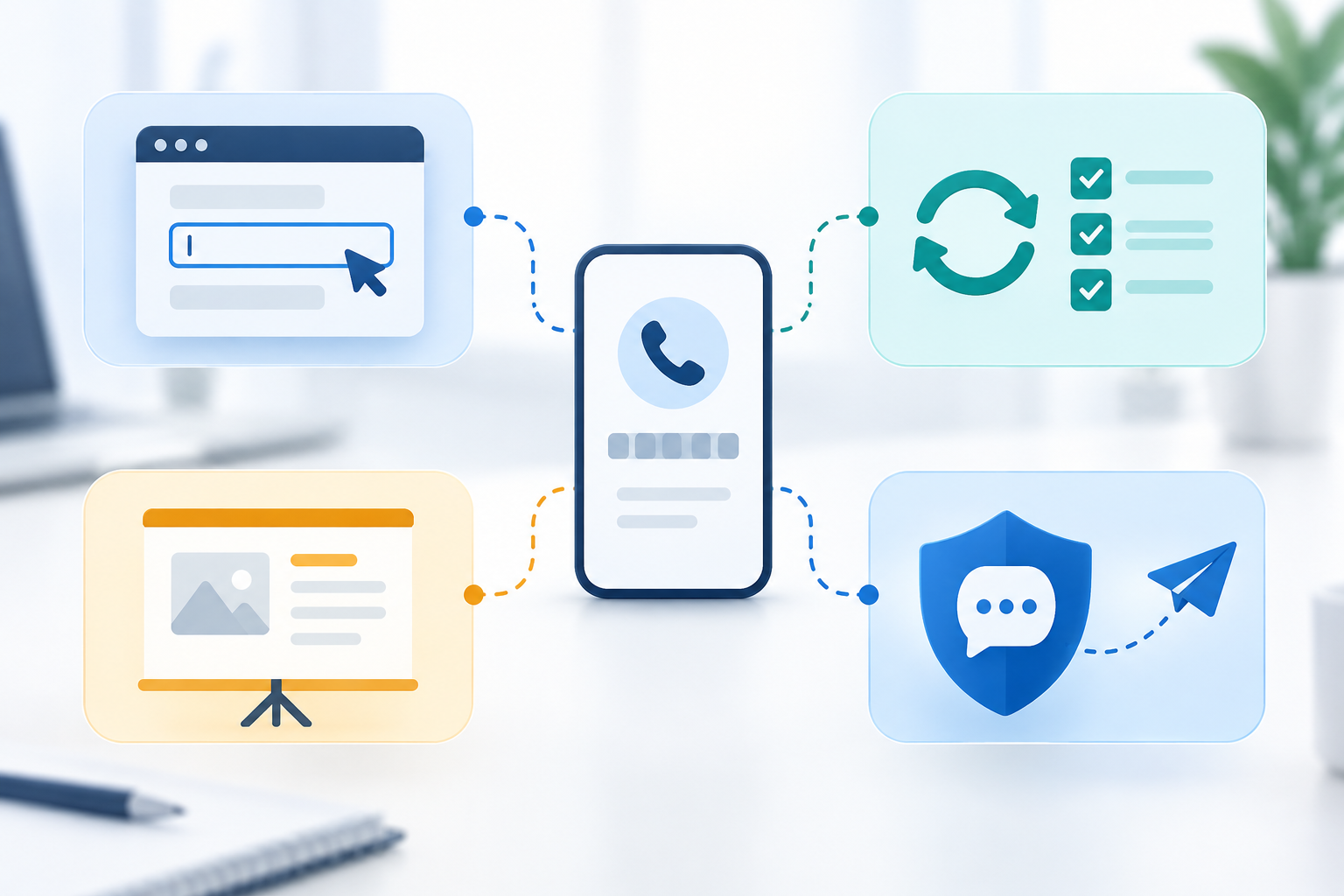
Match the generator to the test
“Phone number generator” can describe several different things. Before choosing one, write down what your test must prove. The same sample value is not suitable for a form layout, an automated regression test and a real message-delivery check.
| Your task | Choose this input | What it can prove | What it cannot prove |
|---|---|---|---|
| Check a form, input mask or country picker | A country-aware synthetic fixture in the format your interface expects | That the UI accepts, displays and normalizes the test case as designed | That the value belongs to a subscriber or can receive a message |
| Keep automated tests repeatable | A small, versioned fixture set with a stable case ID and expected result | That the same input continues to produce the same application behavior | That a randomly generated value will be identical on the next run |
| Prepare a public demo or screenshot | An officially documented fictional example where one exists; otherwise, a visibly labeled placeholder | That a screen or guide communicates the intended format | That an unreserved, realistic-looking value is harmless to contact |
| Check SMS delivery or account ownership | A provider sandbox or a private number your team is authorized to use | Only the delivery or verification step you actually execute in that test environment | Anything about delivery or ownership based on digits generated offline |
For country-specific structure and documented fictional examples, start with the country format dataset and fictional-range review. Keep their source notes with the test case.
Read “valid” as a specific claim
A result can match a numbering pattern without being assigned or reachable. Treat these as separate checks, and label the result at the same level your test actually reached:
- Parseable: the input can be interpreted with a stated country context.
- Format-shaped: its length and pattern fit the structural rules being checked.
- Assigned or reachable: current network or carrier data, or an authorized delivery attempt, supports that claim.
- Controlled by a user: that person completes a consent-based verification step.
A local phone number generator can help with the first two. It cannot establish the last two by producing more digits. The validation guide explains the layers in more detail.
Use a simple fixture contract
Make each generated example explain its own job. A compact contract is easier to review than a large list of unlabeled numbers:
{
  "caseId": "country-picker-national-input",
  "country": "SET_EXPLICIT_REGION",
  "input": "TEST_FIXTURE_FROM_APPROVED_SOURCE",
  "expected": "FORMAT_RESULT",
  "deliveryTest": false,
  "sourceVersion": "RECORD_DATASET_VERSION"
}
Replace the placeholders with a fixture from a reviewed source. Keep the country, expected outcome and data version beside the value. For negative tests, make each case fail for one intentional reason, such as missing country context or an unsupported input shape, so a failure points to a clear rule.
Five checks before you use a generator
- Purpose: does the tool say whether it returns test data or a live service?
- Country context: can you choose a region and see which structural rule is being exercised?
- Repeatability: can you save or recreate an example for a regression test?
- Safety: are fictional-range claims linked to an authoritative source, and are unreserved values clearly marked?
- Delivery boundary: are outbound calls and texts disabled unless an authorized sandbox test requires them?
If any answer is unclear, use a placeholder for the interface test and ask the provider for its documented test mode before attempting delivery.
Keep public and production data out of the fixture loop
Do not paste customer contact data into a public tool, and do not send a test message to a number merely because it looks plausible. Public shared inboxes are not private test lines: other visitors may see messages sent there. Keep account-security checks on a service you control, with consent and a sandbox or isolated test account.
For a production workflow, keep fixture generation separate from the contact database. Disable outbound SMS and voice in routine tests, prevent sample data from entering analytics, and log test case IDs instead of full phone values.
Choose the next tool
For format exploration, use the phone number generator. For repeatable batches, use the bulk fixture generator. For a safer data workflow, continue with the test-data guide and the release checklist.
Frequently asked questions
Does a valid-looking generated number mean it is active?
No. A format check describes structure. It does not establish assignment, reachability, SMS capability or subscriber identity.
Can I use a generated number to test an OTP?
Use a provider sandbox or an authorized private test line for delivery tests. A synthetic fixture is appropriate for form and validation behavior, not for receiving a real one-time code.
Why keep a fixed fixture if the tool can generate random values?
Fixed cases make regressions reproducible. Randomized cases can explore additional inputs, but record the seed or resulting case when you need to investigate a failure.